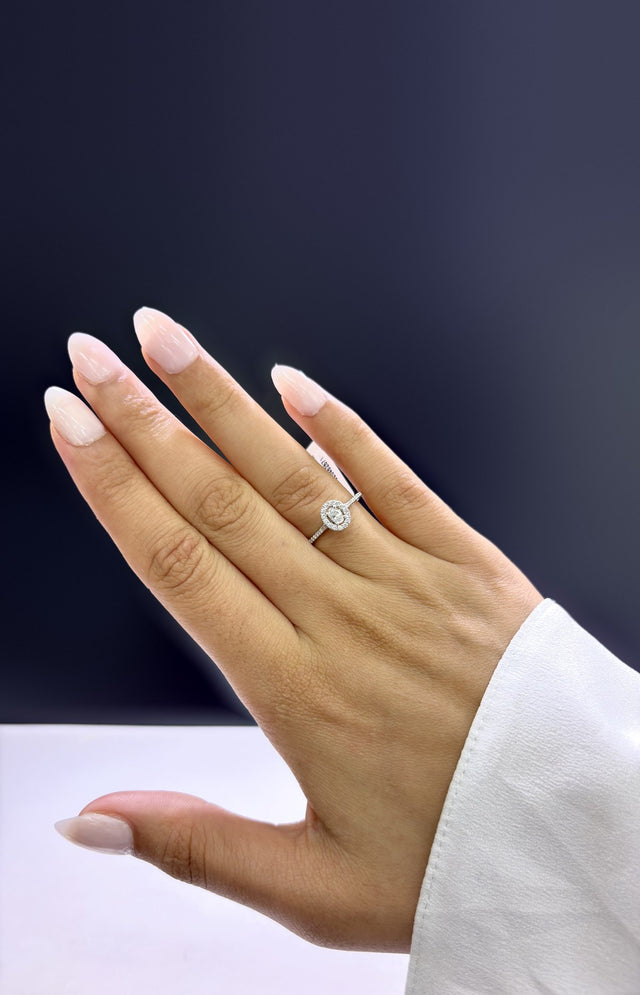
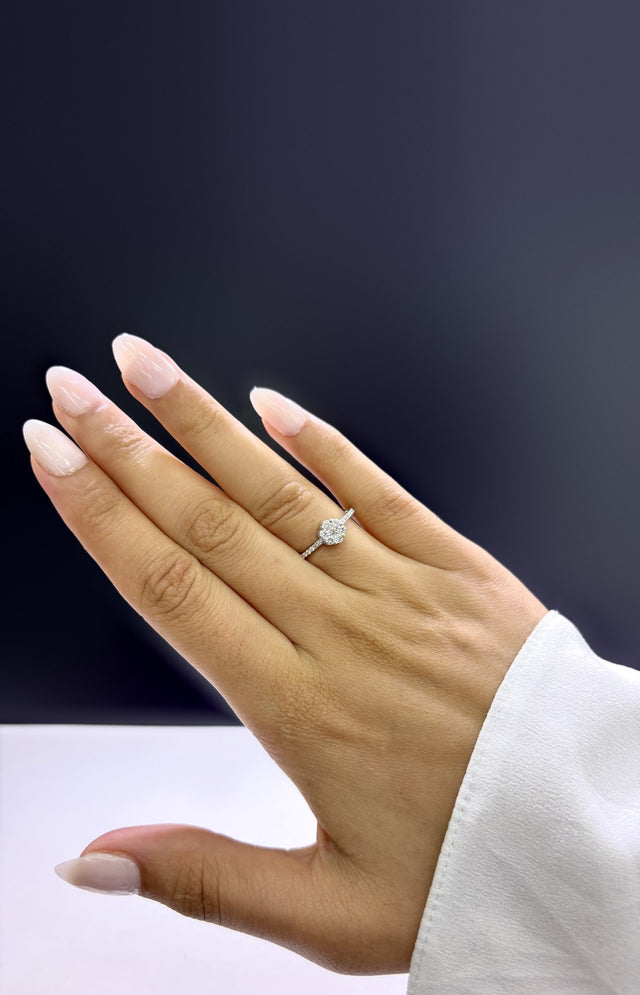
A wedding ring is chosen to be worn every day for decades. Start with comfort, meaning a width that suits your hand and a profile that feels good on the finger, then the metal. After that, decide whether you want diamonds, knowing that a full circle of stones makes resizing very difficult.
Which width of wedding ring should you choose?
Width is measured in millimetres and changes the whole look of the band. Most plain wedding rings are between 2 and 8 mm. At around 2 mm, the ring is slim and steps back beside an engagement ring. Between 3 and 4 mm, it holds its own on the hand. From 5 or 6 mm, it becomes a bold piece, often chosen for long or broad fingers.
No width is reserved for men or for women. Look at proportion instead: a wide band shortens a short finger, a very slim band can look lost on a large hand. Try several widths one after the other, the difference between 3 and 4 mm always comes as a surprise.
A practical detail: the wider the band, the tighter it feels, because it covers more skin. From about 6 mm, many jewellers advise a slightly larger size than for a slim ring, in the order of one millimetre of finger circumference (half a US size). The most reliable way is still to try on a band of the same width. Our article on measuring your ring size explains how to go about it, and the downloadable size guide lets you check at home.
Flat, D-shape or comfort fit: which profile?
The profile is the shape of the band seen in cross-section. You notice it less than the width in a shop window, and far more on the finger.
| Profile | Outside | Inside | How it feels |
|---|---|---|---|
| Flat | Straight, crisp edges | Flat | Modern look, edges more noticeable between the fingers |
| D-shape | Rounded | Flat | The classic, soft to the eye and to the touch |
| Comfort fit | Rounded or flat | Slightly rounded | Less pressure on the skin, pleasant on a wide band |
The rounded inside of the comfort-fit profile reduces the area of metal in contact with the skin. It is a real advantage for anyone who has never worn a ring, which is the case for many people about to marry. The size you feel can change from one profile to another: have it checked on the profile you are ordering.
Do the two wedding rings have to match?
Nothing requires it. Some couples take the same design in two widths, others keep only the same metal, and others again each choose on their own. Two different hands and two different daily lives justify two different rings. If you want a link between the two, the same colour of gold or the same engraving inside is enough.
And with the engagement ring?
Here the match matters more, since the two rings are worn side by side. The same colour of gold gives a clean set. Mixing yellow gold and white gold is also done, provided it is deliberate.
Check above all how they sit together. A stone set high lets a straight wedding ring slide in against the band. A stone set low, or a wide halo, can leave a gap between the two rings, and you then need a slim wedding ring or a curved one that follows the setting. The safest way is to try the wedding ring with the engagement ring on your finger. If you have not yet chosen the engagement ring, read our comparison of solitaire, halo, pavé and trilogy settings first.
Plain, half-pavé or full eternity band?
The plain band
A band of metal with no stones. It is the easiest to live with: nothing catches, a polish removes the scratches, and a jeweller can make it larger or smaller without any particular difficulty.
The half-pavé
The diamonds cover the visible half of the band, and the underside stays in bare metal. You keep the sparkle on the top of the hand, and the jeweller keeps an area to work on if the size has to change. The stones are also out of harm's way on the palm side, the one that rubs against steering wheels and handles.
The full eternity
The diamonds go all the way round the finger. The effect is the same whatever position the ring is in, which many people love. The trade-off is serious: there is no free metal left to cut or to add, so resizing is very limited, and often impossible without remaking the band. Fingers do change, though, with the years, the seasons, a pregnancy. The size has to be right from the moment you order, and the stones placed under the finger take more knocks. The women's wedding rings let you compare the three families.
Which metal for a wedding ring?
18-carat gold contains 75% pure gold, which is written 750 thousandths. The rest of the alloy gives it its colour and its strength. Yellow gold needs only a polish from time to time. White gold owes its bright whiteness to a layer of rhodium that has to be renewed when it wears. Rose gold takes its tint from copper.
Platinum is also used in jewellery: naturally white, denser, so heavier on the finger. All these metals scratch with wear, none escapes it, and a wedding ring marked by twenty years of life has its charm. To go further, see our article on 18-carat yellow gold, white gold and rose gold, then the men's wedding rings.
Which hand is the wedding ring worn on?
It depends on the country and the family. In France, the United Kingdom or the United States, it is most often worn on the left ring finger. In Germany, Austria or Poland, the custom is rather the right hand. These customs shift from one family to another and none is binding: wear it where you like it, or the way it is done in your family.
Just give a thought to your dominant hand: it is the one that knocks, carries and writes. A pavé wedding ring will suffer a little more there.
When should you order your wedding rings?
Earlier than you might think. Resizing, an engraving or a piece made to order take time, and the weeks before a wedding are already full. Starting to look a few months before the date leaves room to try on, hesitate and correct a size.
Have your fingers measured at the end of the day, at normal temperature, neither after sport nor in very cold weather. For the lead time on a particular design, ask an Oroma adviser, on WhatsApp or at the Sidi Maarouf showroom in Casablanca.
Can a wedding ring be engraved?
The engraving goes inside the band: a date, initials, a first name, a few words. The room available depends on the width. A 2 mm wedding ring takes only a short text in small characters, and a full eternity band sometimes leaves very little free surface.
Two things are worth knowing before you ask for it. An engraved ring is rarely taken back or exchanged, and a later resizing can cut into the text. Ask an Oroma adviser whether engraving is possible on the design you have picked, and have the spelling confirmed in writing.