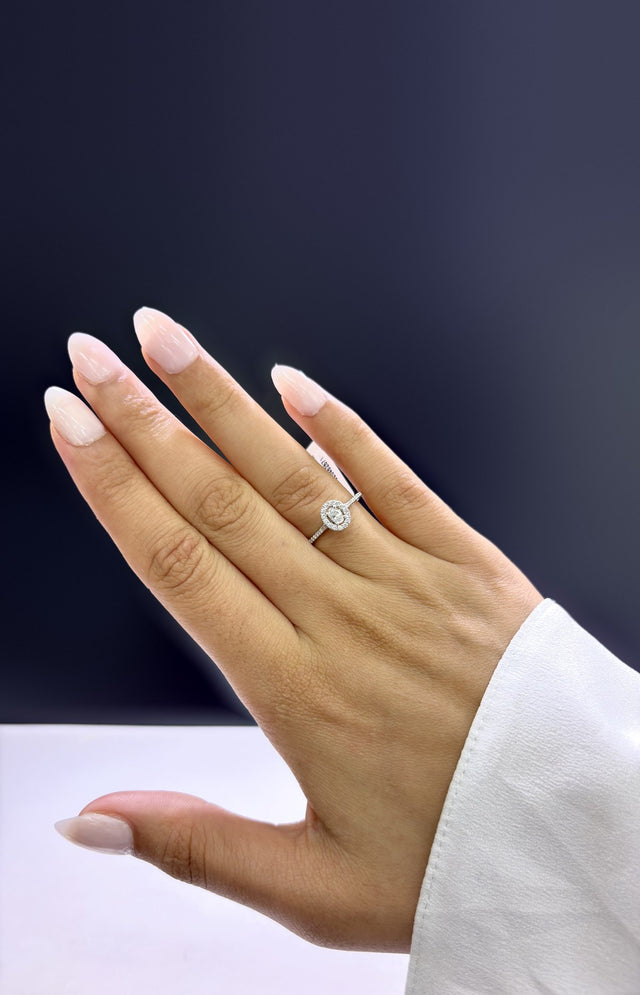
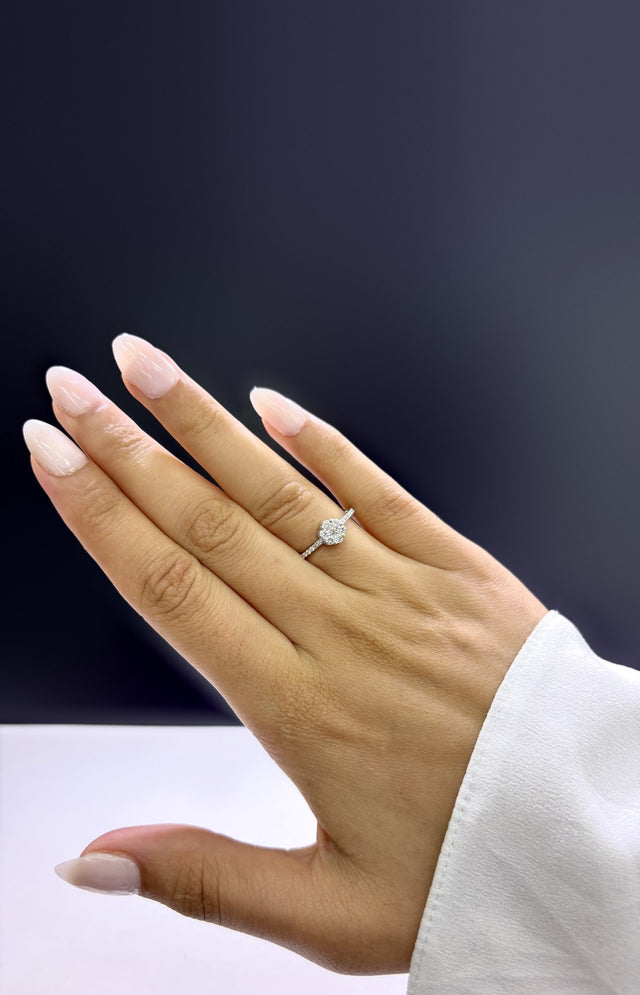
The setting changes the light a diamond receives, the size it appears to be and the protection it gets. A claw-set solitaire shows the most of the stone, a bezel setting protects its edge very well, a halo makes it look larger, and pavé adds sparkle to the band at the cost of a little more upkeep. The right choice depends as much on your days as on your taste.
The solitaire: a single stone, two ways of holding it
A solitaire carries one diamond and nothing else. All the attention goes to the stone, which makes it the setting that asks the most of the stone's quality and the easiest one to clean.
Four claws or six?
Claws are small metal prongs folded over the edge of the diamond. With four claws, the stone is more open to view and a round diamond takes on a slightly square outline. With six, the outline stays round and the hold is more secure: if one claw breaks or spreads, the other five still keep the stone in place, whereas with four it can already slip out.
The shape of the stone often decides for you. Cuts with points (pear, marquise, princess) call for V-shaped claws that wrap the corners, where the diamond is most exposed to chipping. The outlines of each cut are described in our article on diamond shapes.
The bezel setting
Here a band of metal surrounds the whole perimeter of the stone. Nothing sticks out, nothing catches in the knit of a jumper, and the edge of the diamond is shielded from knocks. It is one of the most protective settings.
In exchange, the metal covers the edge of the stone and less light comes in from the sides. On a well-cut diamond, the sparkle comes mostly from the top, so the difference stays moderate. The circle of metal also draws a crisp outline that gives presence to a small stone.
The halo: a circle of small diamonds around the centre
A halo surrounds the centre stone with a row of small diamonds. Seen from a metre away, the eye reads the whole as one bright surface, and the centre seems larger than it is. It is the most direct way to gain apparent size without going up in carat weight, a point developed in our article on the 4Cs of a diamond.
Its small stones are held by tiny beads or claws of metal. There are many of them to keep an eye on, and cream readily settles between them. Allow for more regular cleaning than with a solitaire.
Pavé and micro-pavé on the band
Paving a band means setting diamonds on it tightly against one another, to the point where the metal almost disappears. Micro-pavé takes the idea further with stones of around a millimetre, which the setter places under a microscope. The band glitters with every movement of the hand and accompanies the centre stone without competing with it.
In practice:
- Each small stone is held by very little metal. A knock on the side of the band can dislodge one.
- Resizing is more limited, since bending the band shifts the settings. The further the pavé goes round the finger, the less room the jeweller has.
- The vibrations of an ultrasonic cleaner can shake out a stone that already has some play. You need to check that everything is secure before and after the bath.
Nothing dramatic, but a pavé band needs regular checks. The steps are set out in our guide to caring for diamond jewellery.
The trilogy: three stones side by side
The trilogy lines up a centre stone and two side stones, generally a little smaller. It covers more of the width of the finger than a solitaire and offers a lot of bright surface for a total weight spread over three diamonds.
The harmony rests on colour. Side stones more tinted than the centre are noticed straight away, because the eye compares them without meaning to. The GIA advises staying within about two colour grades of the centre. As for upkeep, there are three stone undersides to brush and more claws to have checked.
Cathedral and tension settings, in brief
A cathedral setting links the band to the head of the ring with two arches of metal that rise on either side of the stone. These arches support the head of the ring and carry the stone higher. That height has its downside: the ring catches more easily on pockets, gloves and hair.
In a tension setting, the diamond seems suspended between the two ends of the band, which hold it by pressure alone. The effect is striking and the stone very open to view. For the GIA, it can be a riskier choice for an engagement ring, because a hard knock can shift or loosen the stone. Resizing is difficult, sometimes impossible, since the whole hold relies on the tension of the metal, and cleaning has to stay gentle.
The settings compared
| Setting | Effect on the stone | Protection | Upkeep |
|---|---|---|---|
| 4-claw solitaire | Stone very open to view | Edge of the stone exposed | Simple, claws to be checked |
| 6-claw solitaire | Fully round outline | More secure hold than with four | Simple |
| Bezel setting | Crisp outline, less light from the sides | Very good, edge covered | Very simple |
| Halo | Centre looks larger | Depends on how the centre is set | More regular |
| Pavé band | Sparkle all along the band | Small stones exposed | Regular checks |
| Trilogy | Width and bright surface | Depends on how the stones are set | Three stones to clean |
| Tension | Stone as if suspended | Sensitive to hard knocks | Gentle, resizing difficult |
Which setting for an active life?
If you work with your hands, often wear gloves, play sport or have young children, look for a low, smooth ring. A bezel setting or a six-claw solitaire sitting close to the finger, on a band that is plain or paved on the upper half only, gets through daily life without trouble.
By contrast, a very high cathedral, a micro-pavé that goes all the way round or a tension setting suits someone who readily takes their ring off, or keeps it for certain occasions. Ask yourself the question frankly: are you going to take it off before the gym, every day, for years?
Think too about the wedding ring that will sit against the engagement ring. A low head or a wide halo can stop a straight band from sitting flush against it, as our article on choosing your wedding rings explains. The other criteria, from shape to metal, are covered in how to choose an engagement ring.
A setting is judged on the finger and from the side, not only face-on in a photo. Browse the Oroma engagement rings, then ask to see a piece at the Casablanca showroom from the contact page or on WhatsApp.