


No. With the naked eye as with a loupe, the two origins look alike. Only the instruments of a gemmological laboratory can read how the crystal grew, in the Earth, in a press or in a CVD chamber. That is why the report and the invoice matter so much.
Laboratory-grown diamonds in Morocco: what to know before buying
A laboratory-grown diamond is a diamond, with the same carbon crystal, the same hardness and the same sparkle as a stone taken from a mine. In Morocco, it is bought with the same precautions: a report from an independent laboratory that spells out the origin, and an invoice that repeats it. Oroma Diamond sells jewellery set with laboratory-grown diamonds and other pieces set with natural diamonds, which lets you compare the two with the same adviser.
What is a laboratory-grown diamond?
It is carbon that crystallises exactly as it does in nature, but in a few days or a few weeks. There are two processes. HPHT (high pressure, high temperature) recreates the conditions of the Earth's mantle in a press. CVD grows the crystal layer by layer in a vacuum chamber, from a carbon-rich gas. The rough stone is then cut and polished like a mined stone.
The result scores 10 on the Mohs scale, scratches glass and can be worn every day for decades. The technique is nothing new: the first gem-quality stones date from 1970, and production in quantity from the mid-1990s.
It should not be confused with imitations. Moissanite (silicon carbide) and zirconium oxide also come out of a laboratory, but they are different materials, less hard, with different reflections. On a label, “made in a laboratory” therefore proves nothing. Look for the word diamond.
Laboratory-grown or natural: what changes for you?
Neither is better than the other. What separates them is the origin, and what it means for the price and for resale.
| Criterion | Natural diamond | Laboratory-grown diamond |
|---|---|---|
| Material and hardness | Carbon, 10 on the Mohs scale | Identical |
| Sparkle | Depends on the cut grade | The same, for the same cut |
| Formation | In the Earth, a very long time ago (up to several billion years) | In a machine, in a few days or weeks |
| Price for equal characteristics | Higher | Much lower |
| Resale | Long-established second-hand market, but resale below the purchase price | Very thin second-hand market, buy-back generally low |
| On the report | Natural origin | The words “laboratory-grown”, often with the process |
To the eye, even under a loupe, they cannot be told apart. The choice therefore comes down to what matters to the two of you: the rarity and age of the stone on one side, a bigger or better-graded stone for the same sum on the other. Our article natural diamond or laboratory-grown diamond looks in detail at how the stones form and at resale.
How do you buy a laboratory-grown diamond with confidence?
The difference between the two origins cannot be seen, yet the price changes a great deal. Everything therefore rests on what is written down.
The laboratory report
For a centre stone, ask for the report of an independent gemmological laboratory, the GIA or the IGI for example. It must state clearly that the stone was produced in a laboratory. Its number can be checked on the laboratory's website: type the address yourself rather than following a link or a QR code supplied by the seller, then compare the weight to the hundredth of a carat and the dimensions.
Two reports may not look alike. Since 1 October 2025, the GIA no longer gives colourless laboratory-grown diamonds the colour and clarity grades used for natural stones: it classes them as Premium or Standard. Its older reports remain valid.
The invoice
Law 31-08 on consumer protection requires the seller to give you an invoice or an equivalent document. For a laboratory-grown diamond, ask for it to state:
- the words “laboratory-grown diamond” in full;
- the weight, the shape, and the grades or the category given by the report;
- the name of the laboratory and the report number;
- the metal and its fineness, for example 18 carat gold (750).
The gold hallmark and the laser inscription on the girdle can also be checked. Everything is explained in buying a diamond with confidence in Morocco.
What sets the price of a laboratory-grown diamond?
The same criteria as for a natural diamond. Weight counts most, and the price jumps at certain much-sought thresholds, such as 0.50 or 1 carat. Next comes the cut grade, which creates the sparkle, then colour and clarity, whose highest grades cost a lot without being visible once the stone is set. The setting and the metal are added to the stone. To read these criteria without getting them wrong, see the 4Cs of a diamond.
Prices for laboratory-grown diamonds have fallen a great deal in recent years. A figure given here would soon be wrong. Ask an Oroma adviser instead what your budget allows today, in laboratory-grown and in natural, for the shape you like.
How Oroma helps you choose
Advice and orders go through WhatsApp or the contact page. To save time, give your ceiling, the shape and the colour of gold you have in mind straight away, and say whether you are torn between the two origins. You can ask to see, when possible, a piece of each origin for the same shape and the same budget.
A few questions to ask before you decide:
- Which laboratory issued the report, and can I check its number before I travel?
- Will the origin appear on the invoice?
- Will the original report be handed to me with the piece?
- Can this design be resized if needed?
If you can come to Casablanca, ask to see the pieces at the showroom in Galerie Panorama, in Sidi Maarouf. Our page on our diamond jeweller in Casablanca explains how to prepare the visit. If you are weighing up a solitaire, a wedding ring or an everyday ring, read our page on diamond rings in Morocco, then browse the engagement rings.
Our pages by city
Laboratory diamond rings

Laboratory diamond
Bague solitaire diamant de laboratoire - Princesse 1 ct, anneau pavé
17,000.00 Dhs
Laboratory diamond · 1 ct
Bague poire anneau croisé pavé diamant de laboratoire 1 ct - Or blanc 18K
14,700.00 Dhs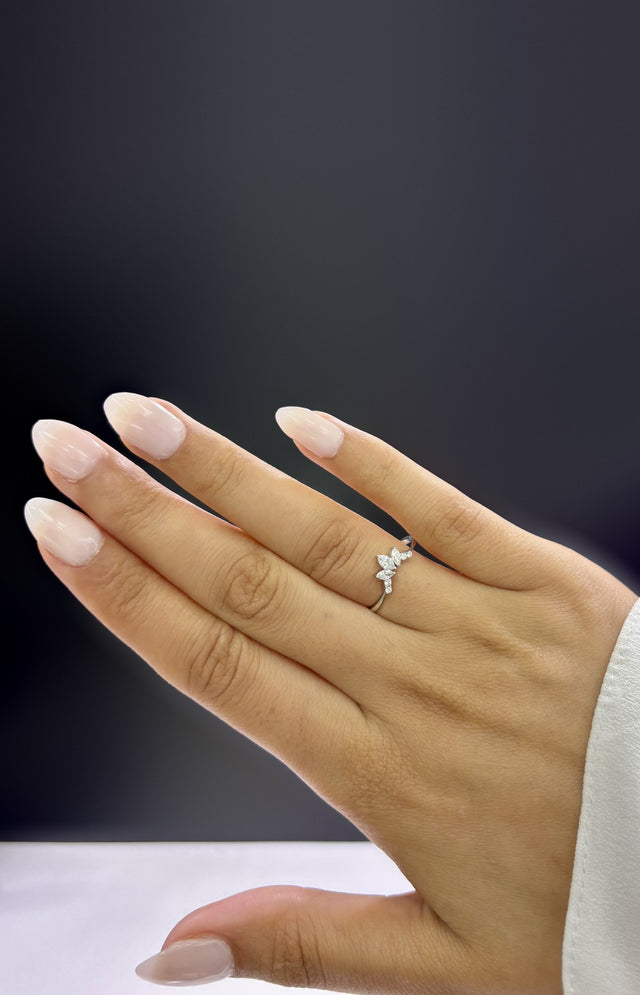
Laboratory diamond · 0.6 ct
Bague couronne trois marquises diamants de laboratoire 0,6 ct - Or blanc 18K
8,900.00 Dhs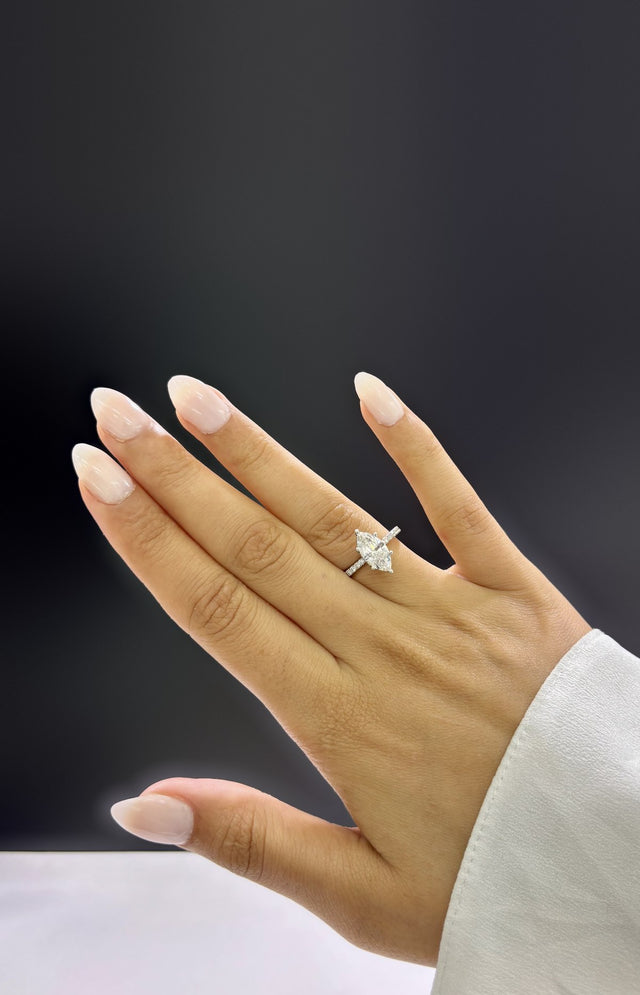
Laboratory diamond · 1.5 ct
Solitaire marquise pavé diamant de laboratoire 1,5 ct - Or blanc 18K
20,900.00 Dhs
Laboratory diamond · 1.2 ct
Solitaire poire pavé diamant de laboratoire 1,2 ct - Or blanc 18K
16,900.00 Dhs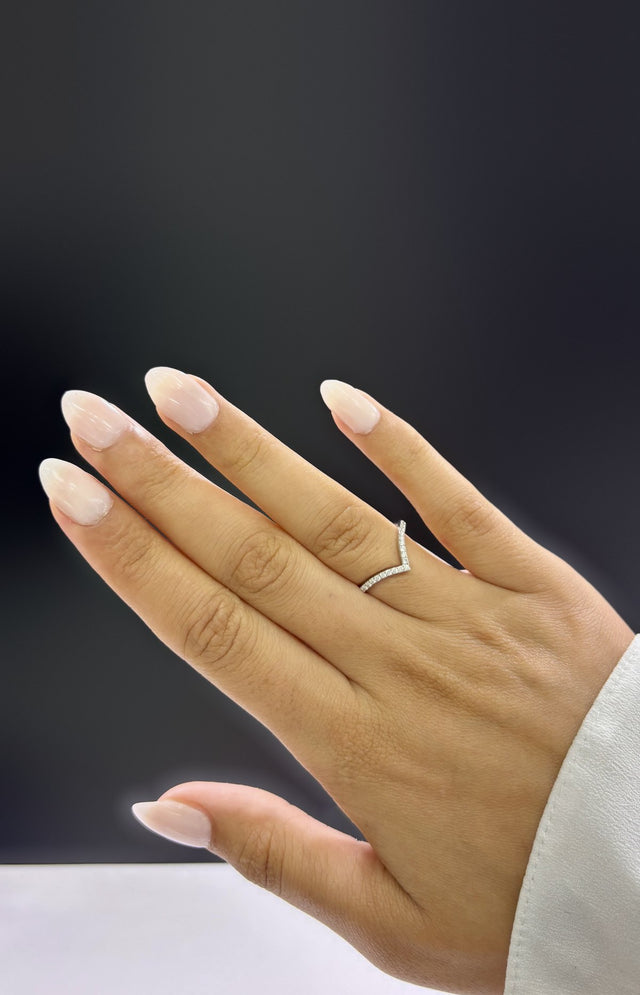
Laboratory diamond · 0.3 ct
Alliance chevron pavée diamants de laboratoire 0,3 ct - Or blanc 18K
5,900.00 Dhs
Laboratory diamond · 0.7 ct
Bague marquise ornée diamant de laboratoire 0,7 ct - Or jaune 18K
12,100.00 Dhs
Laboratory diamond · 1.8 ct
Solitaire ovale anneau serti diamant de laboratoire 1,8 ct - Or blanc 18K
25,400.00 DhsFrequently asked questions
Materially, yes: it has the hardness of natural diamond and stands up to daily wear. The question is more a personal one. Some people care about a stone formed in the Earth, others prefer a bigger stone for the same budget, and it is better to know what your partner thinks before buying.
In exactly the same way, since it is the same material. It does not turn yellow and does not scratch in daily use, but it attracts grease like any diamond. A bath of lukewarm water with a few drops of washing-up liquid and a soft brush bring back its sparkle; have the claws checked from time to time too.
Not easily at a good price. The second-hand market is very small and new stones keep getting cheaper, so a second-hand stone finds few buyers. If resale matters to you, ask the question before buying; if the ring is made to be worn, this point weighs less.