




Nothing requires it. Choosing the bride's wedding ring with the engagement ring to hand does, however, avoid unpleasant surprises with how they fit together. If you buy in two stages, leave some margin before the wedding: a resizing or an engraving takes days.
Diamond rings in Morocco: choosing the right one and buying it well
A diamond ring is most often an engagement ring, built around one stone, a wedding ring, made to be worn every day, or a ring you treat yourself to for no particular occasion. To choose one, set a budget, then decide on the stone, the metal, the setting and the finger size. To buy it in Morocco, insist on a laboratory report for the centre stone and a detailed invoice.
The engagement ring
It generally carries one main stone, and the setting is what gives it its style. Four are the most common:
- the solitaire, a single stone on a plain band, easy to pair with a wedding ring;
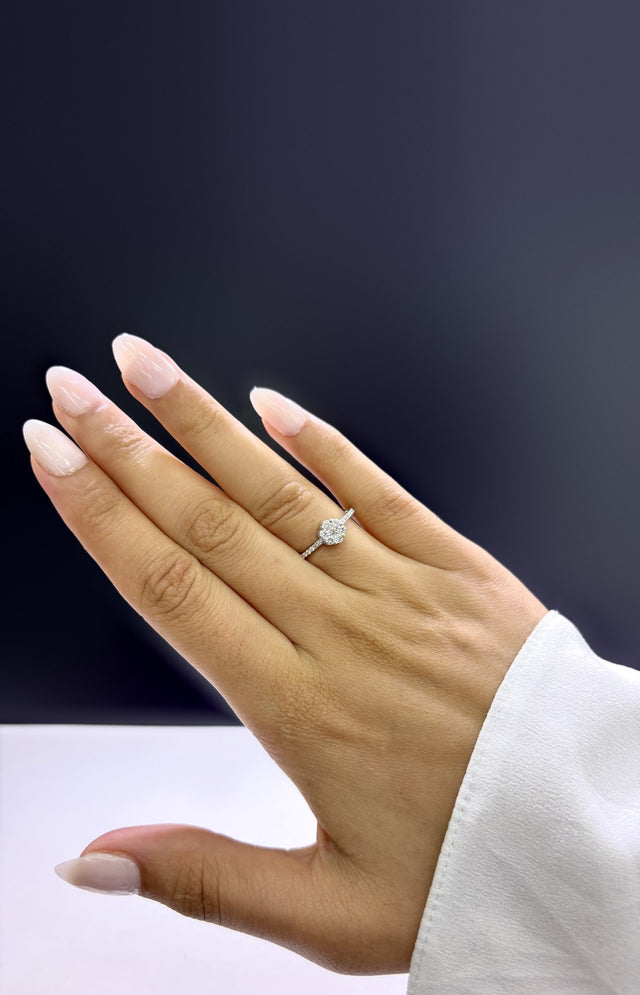
- the halo, a circle of small diamonds around the centre stone, which makes it look bigger;
- the pavé, with small stones set along the band;
- the trilogy, three stones in a row, the largest in the middle.
The shape of the stone matters just as much. The round brilliant sparkles the most. The oval and the pear look bigger for the same weight. The emerald cut, with its long facets, has a more understated look but shows the slightest inclusion. Our guide on how to choose an engagement ring takes these decisions in order, and the designs are gathered in the engagement rings collection.
Wedding rings
A wedding ring is worn for decades, often without ever being taken off. Comfort therefore comes first: a width that suits the hand, and a profile that feels good on the finger. Most plain wedding rings are between 2 and 8 mm wide, and a slightly rounded inside, called “comfort fit”, is felt less.
As for diamonds, there is the plain band, with no stones, the easiest to live with and to resize. The half eternity is set with pavé on the visible half and keeps bare metal under the finger. The full eternity, set all the way round, can hardly be altered: it is ordered in the exact size.
If the wedding ring goes with an engagement ring, try the two together. A stone set low or a wide halo can leave a gap between the bands. Our article on choosing your wedding rings compares widths, profiles and metals.
Rings to wear for yourself
Not every diamond ring marks a commitment. A half eternity looks very good on its own, on the index or middle finger. Thin pavé bands can be stacked. A ring with a bigger stone, or a very elaborate one, is kept for evenings out. On these rings, you can be less demanding about the grades: small, well-set stones sparkle a great deal, and on yellow or rose gold a slightly lower diamond colour goes unnoticed. Browse all our rings to get an idea.
How do you choose a diamond ring?
The budget first
Set a ceiling before looking at designs. The weight of the main stone makes up most of the price, and it rises in steps, at 0.50, 0.70 or 1 carat. A stone just under a threshold costs noticeably less, for a difference nobody can see on the finger.
The stone: natural or laboratory-grown
A laboratory-grown diamond is a diamond, with the same hardness and the same sparkle. For equal characteristics, it costs much less; the natural diamond has its rarity and its age on its side. Oroma Diamond offers both, and our page on laboratory-grown diamonds in Morocco helps you decide.
The metal
In fine jewellery, gold is most often 18 carat, meaning 75% pure gold, which is written 750. The colour comes from the metals added. Yellow gold remains the most classic. White gold is usually plated with rhodium, which has to be redone from time to time, and rose gold owes its tint to copper. The best clue is still what the person already wears.
The finger size
The European size is the circumference of the finger in millimetres: a size 52 corresponds to 52 mm. The Oroma size guide can be downloaded and printed. Measure at the end of the day, and allow a little more room for a band of 5 or 6 mm or wider, which feels tighter.
Everyday life
A stone set high catches on jumpers and gloves. For someone who works with their hands, a low setting or a bezel setting, where the metal surrounds the stone, holds up better. Diamond has little to fear: it is the hardest mineral. The claws, on the other hand, need checking from time to time.
Buying a diamond ring in Morocco
The same checks apply with every seller. For the centre stone, ask for the report of an independent laboratory and check its number on the laboratory's website. Have the weight, the grades, the natural or laboratory-grown origin and the fineness of the metal written on the invoice. Look for the hallmark inside the band, and see the ring before paying whenever you can. The details are in buying a diamond with confidence in Morocco.
At Oroma Diamond, advice and orders go through WhatsApp or the contact page. Give the adviser your budget, the kind of ring you are interested in and, if you have it, the size. You can also ask to see a piece at the Sidi Maarouf showroom; our page on our diamond jeweller in Casablanca explains how to prepare the visit.
Our pages by city
Diamond rings in Morocco

Natural diamond · 0.7 ct
Bague double halo baguette pavé diamants naturels 0,7 ct - Or blanc 18K
16,400.00 Dhs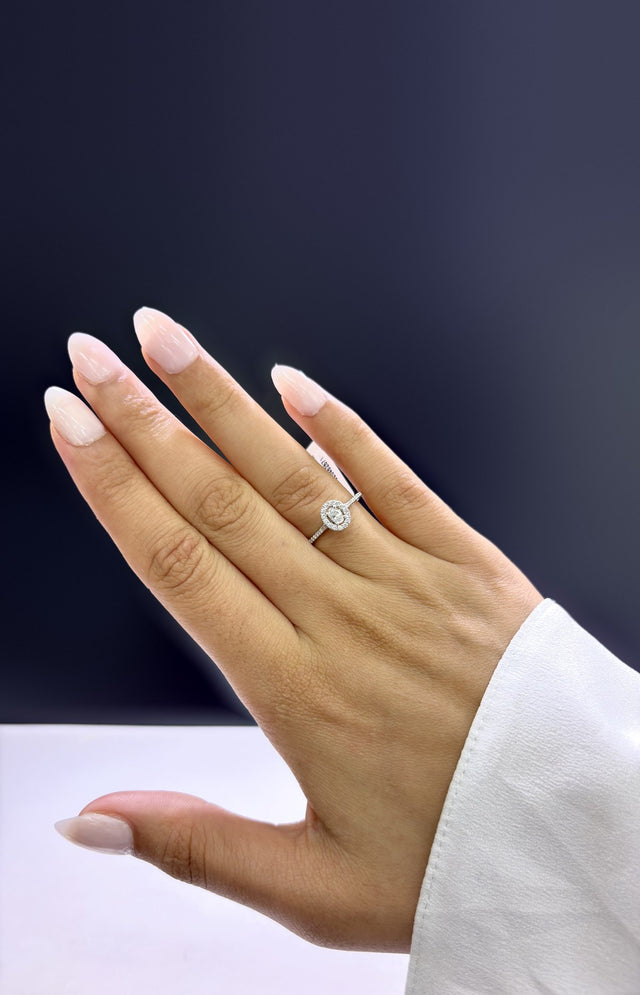
Natural diamond · 0.35 ct
Bague halo rond pavé diamants naturels 0,35 ct - Or blanc 18K
9,900.00 Dhs
Natural diamond · 0.9 ct
Bague double halo baguette double anneau diamants naturels 0,9 ct - Or blanc 18K
19,900.00 Dhs
Natural diamond · 0.8 ct
Bague soleil baguette diamants naturels 0,8 ct - Or blanc 18K
17,400.00 Dhs
Natural diamond · 0.4 ct
Bague baguette et pavé diamants naturels 0,4 ct - Or blanc 18K
10,400.00 DhsFrequently asked questions
Often, when the band is plain metal: the jeweller cuts it, adds or removes a little metal, then solders it again. A full pavé eternity or a tension setting is very hard to alter, sometimes impossible. Ask before buying whether the chosen design can be adjusted, and by how much.
Yes, diamond does not wear down in contact with everyday objects. Still, take it off for sport, gardening or housework, which mark the metal and dirty the stone. Having the claws checked once or twice a year avoids losing a stone.
White gold brings out the whiteness of the stone and shows off the diamonds with the best colour grades. Yellow or rose gold warms the reflections and makes a slightly lower colour less visible. The safest course is still to follow the jewellery the person already wears.